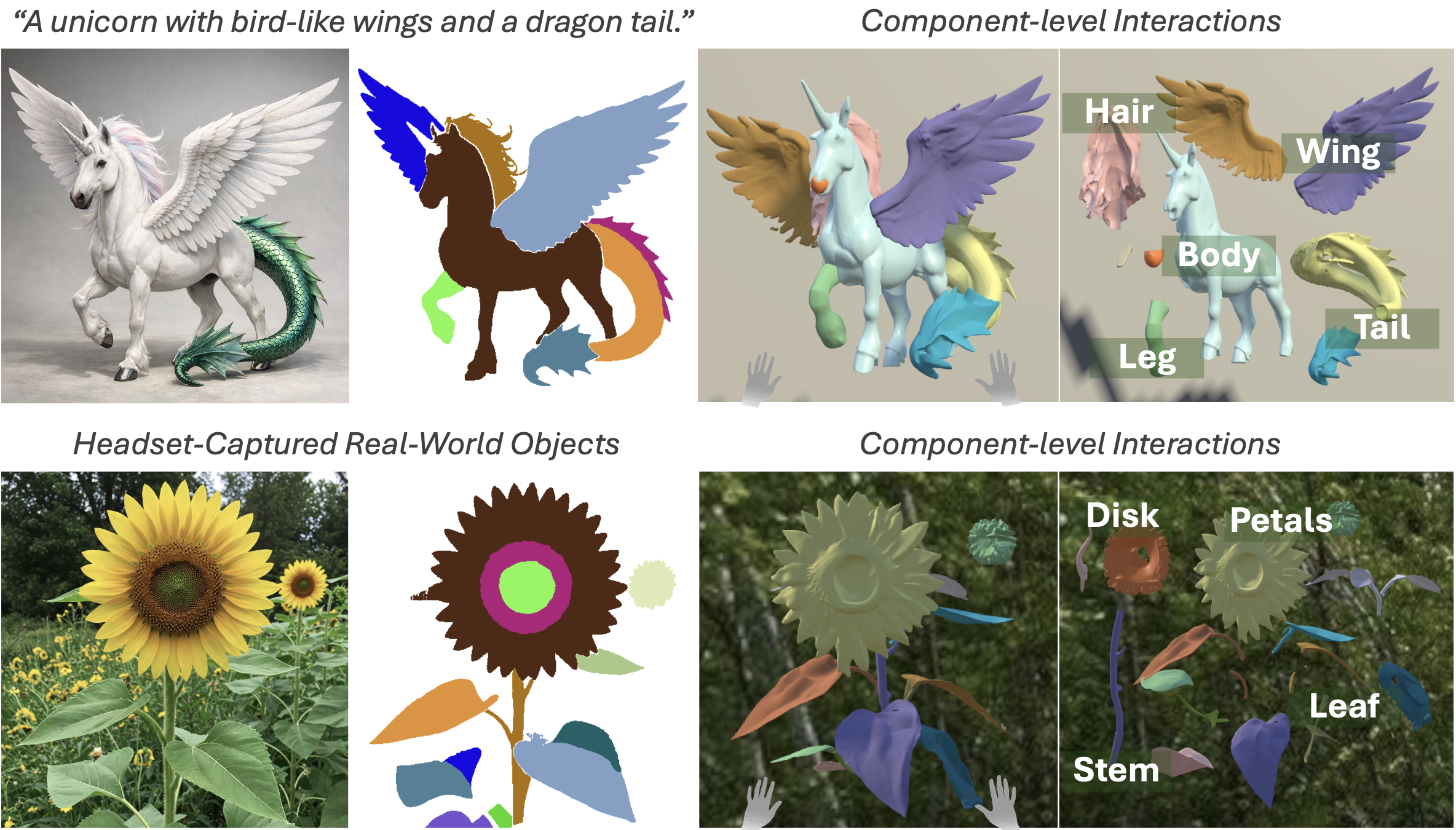
PartInteractor: Intent-Driven Part-Aware 3D Authoring for Continuous Co-Creation in XR

1The Pennsylvania State University
Accepted to ACM UIST 2026

Abstract

As Extended Reality (XR) evolves into an immersive computing medium, interactive 3D authoring becomes essential for creative and functional workflows. However, existing generative XR systems produce monolithic outputs lacking explicit semantic structure, limiting post-generation control.

We introduce PartInteractor, a representation-to-interaction framework that investigates how semantic part hierarchies can be incorporated into generative XR authoring, and exposed as first-class, directly manipulable units, turning one-shot prompt-to-object generation into continuous component-level co-creation.

PartInteractor supports speech, sketch, and image inputs, integrating an LLM interpreter with a retrieval-generation strategy to scaffold user intent prior to 3D generation. Instead of producing monolithic objects, our system generates semantically decomposed 3D assets with explicit part hierarchies, enabling rich component-level interaction over object structure and composition.

Our evaluations suggest that part-aware representation increases post-generation control and reduces reliance on whole-object regeneration, while intent scaffolding mitigates ambiguity and improves intent-result alignment, together supporting more expressive and controllable human-AI co-creation workflows.

These results highlight part-aware representation and intent scaffolding as promising design considerations for future generative XR authoring systems.

System Overview

PartInteractor reconceptualizes generative XR authoring as a human-in-the-loop, representation-to-interaction workflow rather than a one-shot prompt-to-object process. It connects Pre-Generation Intent Scaffolding, Structured Part-Aware Generation, and Post-Generation Component-Level Interaction into a continuous authoring pipeline, allowing users to iteratively externalize intent, generate semantically decomposed 3D assets, and directly manipulate object components within an immersive workspace.

Pre-Generation Intent Scaffolding

Users express design intent through speech, in-situ sketches, or headset-captured images. An LLM/VLM backend interprets the input and presents 2D candidate visuals via retrieval or generation before expensive 3D synthesis, allowing users to confirm or refine intent at lower cost.
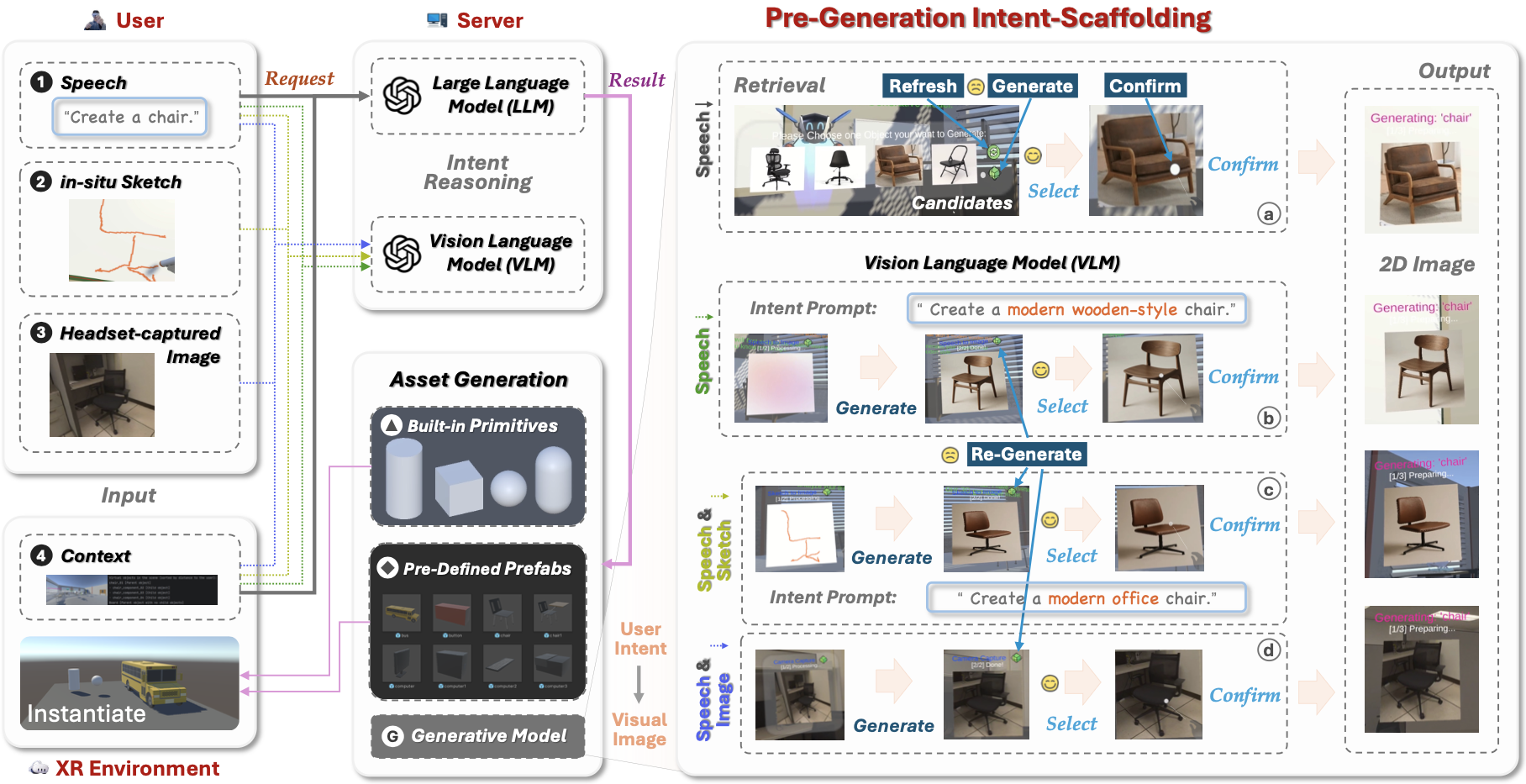
Pre-Generation Intent Scaffolding

Structured Part-Aware Generation

After candidate selection, the system converts the 2D representation into a structured 3D asset with explicit semantic part hierarchies. Rather than producing a monolithic mesh, PartInteractor preserves object components as semantically meaningful and directly editable units, enabling subsequent component-level interaction.

Structured Part-Aware Generation

Post-Generation Component-level Interaction

Generated objects become structured, interactable design artifacts rather than static outputs. By reasoning over XR scene context and part-aware representations, PartInteractor supports flexible, fine-grained interactions at both object and component levels, within and across objects, including manipulation, inspection, editing, restructuring, and appearance customization without whole-object regeneration.
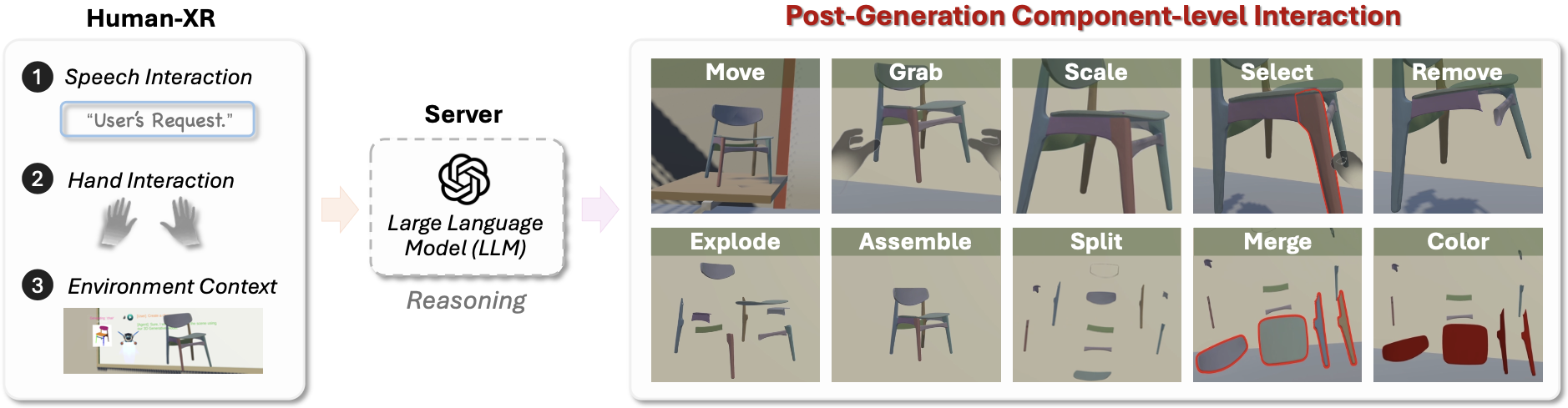
Post-Generation Component-level Interaction

Interactive Generation Results

Explore representative generation results interactively. Select a thumbnail to load the corresponding part layout and generated mesh, rotate the view to inspect each result, and use the explode slider to examine component structure.

Part Layout
Loading...
Generated Mesh
Loading...

Representative Failure Cases

Failure cases include noisy fragments, missing geometry in occluded regions, and fused components.

Part Layout
Loading...
Generated Mesh
Loading...

Evaluation

Multimodal Inputs

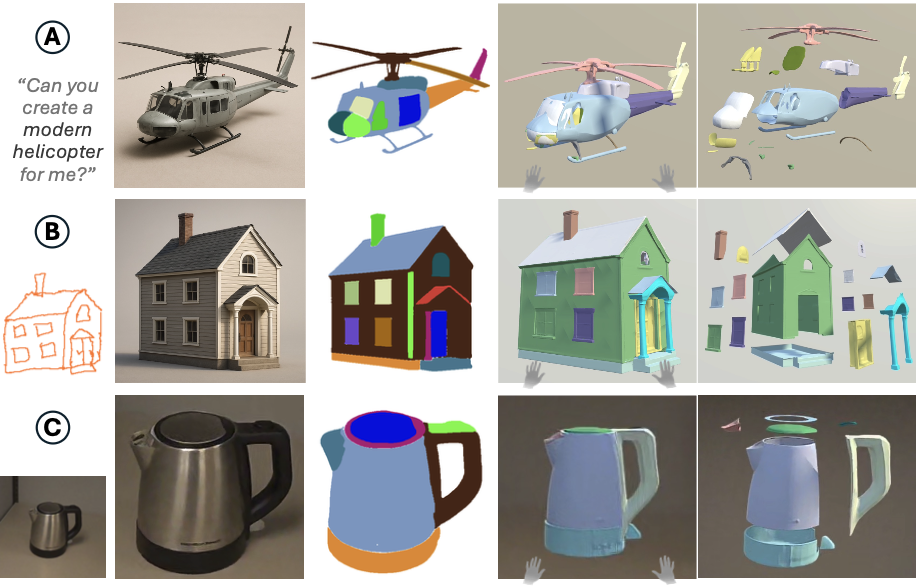
Users can express design ideas through Ⓐ speech alone or in combination with Ⓑ in-situ sketches or Ⓒheadset-captured images.

Multimodal inputs figure


Applications

We further illustrate potential VR and MR scenarios enabled by PartInteractor, suggesting opportunities for creative design exploration and educational learning.

VR and MR application scenarios


BibTeX

@inproceedings{jiang2026partinteractor,
  title={PartInteractor: Intent-Driven Part-Aware 3D Authoring for Continuous Co-Creation in XR},
  author={Jiang, Jianan and Li, Bin},
  booktitle={Proceedings of the 39th Annual ACM Symposium on User Interface Software and Technology},
  pages={1--13},
  year={2026}
}